
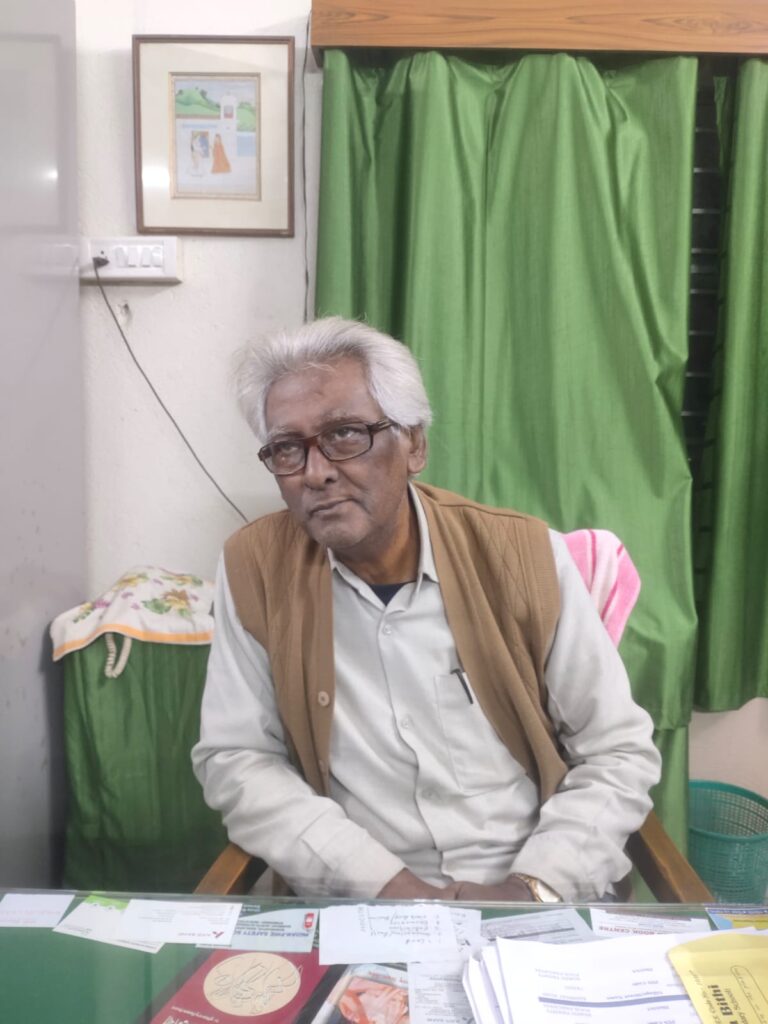
From the Founder’s Desk
Man is naturally a creative being, though this creative faculty varies from person to person. A simple piece of stone can be endowed with meaningful and graceful significance by a skilful artistic hand. To evolve into a genius, a creative mind almost inevitably needs the guidance of a “GURU” (teacher). This underscores the relevance of an ideal institution, supported by committed and capable faculty members, to nurture art and culture among young minds and to contribute meaningfully to social harmony.
India, our motherland, has always been a fertile ground for talent. Throughout history, favourable ambience and patronage have enabled the flourishing and exploration of diverse forms of painting, music, and dance—artistic expressions powerful enough to transcend time. Today, these traditions stand as enduring symbols of our rich cultural heritage.
At different points in history, social and political challenges have tested our collective sense of balance and aesthetic sensitivity—both essential to creative expression. In contemporary times, when life often moves at a rapid pace, it becomes all the more important to remain connected to our traditions and cultural roots, for no society can progress meaningfully without a strong sense of continuity.
In this broader context, the role of institutions dedicated to the promotion of art becomes especially significant. Such institutions respond not only to social needs but also to the inner aspirations of individuals seeking purpose, reflection, and creative expression in the modern world.
With a visionary approach to education, Rabindranath Tagore founded Visva-Bharati at Santiniketan in the twentieth century, where Kala Bhavana, the college of art, was established alongside other academic disciplines. This holistic model of learning reaffirmed the centrality of art in intellectual and cultural life.
In the post-independence period, Rabindra Bharati University was established by the Government of West Bengal in memory of Rabindranath Tagore at his residence in Jorasanko, with a focus on the advancement of visual and performing arts. Institutions such as the Indian Society of Oriental Art, Academy of Fine Arts, Birla Academy of Art & Culture, West Bengal State Academy of Dance, Drama, Music and Visual Arts, Rajya Charukala Parishad, and several other cultural organisations have consistently contributed to the growth and promotion of art through exhibitions, performances, and educational initiatives.
The revival and structured cultivation of art in India gained momentum in the late nineteenth and early twentieth centuries with the establishment of art schools and societies in Kolkata and other centres. Over time, the need for wider access to art education and institutional support became increasingly evident.
Responding to this need, Bengal Fine Arts College was established in 1979 with a commitment to making quality art education accessible and meaningful. Since its inception, the institution has organised a wide range of activities, including Art Development Projects, Art Education Projects, exhibitions, seminars, and workshops, fostering an environment of continuous learning and creative engagement.
The degree college run by the institution was affiliated to Indira Kala Sangit Vishwavidyalaya in 1998. From the academic session 1998–99, the Bachelor of Fine Arts (B.F.A.) four-year degree programme in Painting and Sculpture was introduced, marking a significant milestone in the institution’s academic journey.
Since then, the college has continued its journey of aspiration, endeavour, and achievement. The narrative that follows reflects a sustained commitment to sincerity, dedication, and academic purpose, and affirms the belief that broader accessibility and support can further strengthen the path for aspiring artists.
Sri Debnarayan Debnath, Founder, Bengal Fine Arts College.